
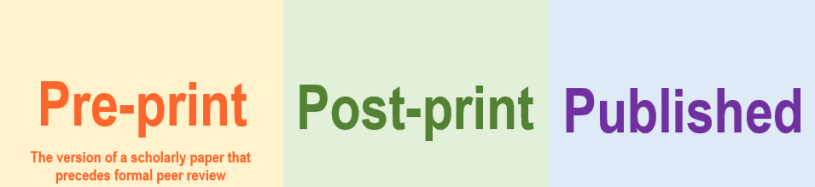
Traditional scientific publishing is slow and is often pay-walled. That is, there is normally a long delay between submitting your manuscript for publication and that manuscript being published (and therefore, accessible to your peers and other stakeholders, such as clinicians and patients) and people who want to read your work often have to pay a fee/subscription to access the journal article (although this is less common now, because of open-access publishing).
Pre-prints address both of issues – there is little/no delay between you submitting a pre-print and others being able to access it, and they are free to post and read. Preprints are “scientific documents made available outside of the traditional publisher-managed framework
and often disseminated online via trusted repositories” (Moshontz et al. 2022, p. 1) such as pre-print servers (e.g., PsyArXiv or bioRxiv). Typically (at least in my experience), researchers use pre-prints in the following way. At the point that they are ready to submit a manuscript for publication to a traditional journal for peer review, a researcher will submit that manuscript to a pre-print server (such as PsyArXiv; as we did here: doi.org/10.31219/osf.io/tpf3d). After a light-touch moderation process, that pre-print is accessible to all and free to read. In this way, pre-printing your work makes it available to any interested reader, very rapidly. Pre-printing doesn’t interfere with the traditional publication process (almost all journals are happy for you to preprint your work), but it is a good idea to mention in your cover letter that you have pre-printed your manuscript (to avoid any confusion for the editor).
Pre-prints can also be used in slightly other ways, too. Rather than submitting a pre-print just as you are about to submit to a traditional journal, you could submit a pre-print weeks/months before you intend to submit to a traditional journal so that you can receive feedback from your peers about how the work could be improved.
Or you may use pre-printing in cases where you want to disseminate research, but you don’t intend to engage with traditional scientific publishers. For example, I have done that here – doi.org/10.31234/osf.io/a32yw – where my MSc student ran a really good project, and we wanted to share the findings/data from it. But we thought that a traditional journal would ask us to replicate the findings, and we didn’t have the resources to do so (as the MSc student had completed their studies, and the project is a little bit beyond my area of expertise). And I plan to use pre-printing to disseminate this – https://doi.org/10.17605/osf.io/t7vdc – project (where I have made tasks from ‘old’ publications available), as I don’t think a traditional journal would be keen to publish a paper describing that project.
Pre-printing your work, therefore, makes your work accessible to all, much more rapidly than via traditional scientific publishing. And it is more flexible, so you can use the process to gather extra feedback prior to engaging with traditional scientific publishing, or to publish what you want, how you want.
That said, there are some ‘costs’ associated with pre-printing. For consumers of pre-prints, there are very few ‘quality controls’ (e.g., there is no peer review, or no action editor checking the quality of the manuscript. Although it is debatable how rigorous traditional peer-reviewing/editing is). And so they may end up reading/using very low quality research. For researchers, engaging in pre-printing takes a little extra time versus solely engaging in traditional scientific publishing. And that is the main ‘cost’. Many people have concerns about things like ‘scooping’ but pre-printing should reduce, rather than increase, the likelihood of you being scooped (as posting a pre-print allows you to demonstrate, as they are time-stamped documents).
If you are interested in pre-printing, then have a look at these slides – https://docs.google.com/presentation/d/1j0rUPn6xjjEcZyDeNYqcYDS3APudSSdf/edit – I gave on pre-prints for ECHR. But probably more useful is this – https://journals.sagepub.com/doi/full/10.1177/25152459211019948 – great tutorial on pre-printing from Moshontz et al. (2021).
 Early Career Hallucinations Research Group