
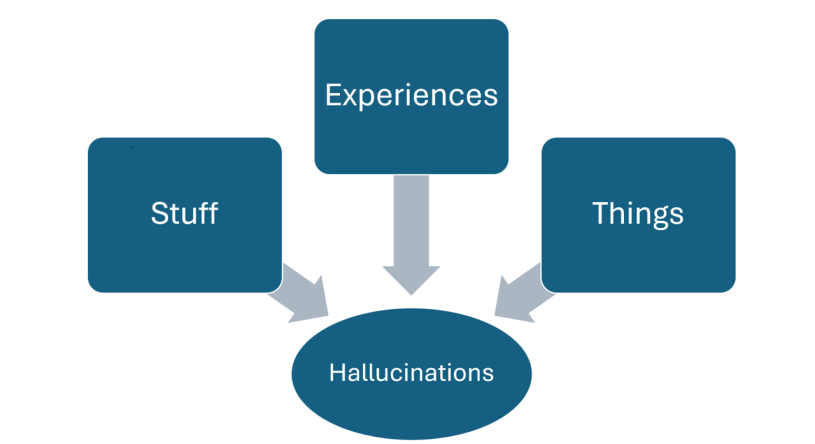
As we’ll see/have seen in other posts, there are many reasons why we have been generating an unreliable, untrustworthy evidence base. However, one pretty fundamental problem raised by some researchers is that the models we employ are too vague. That is, they are expressed verbally and/or using imprecise box-and-arrow diagrams that allow us to make predictions that are too broad to genuinely help progress our understanding of how experiences like hallucinations develop.
In their excellent paper on why suicide researchers should move away from the use of verbal models towards the use of formal models, Millner et al. (2020, page 707) write, “rather than developing theories of suicide comprising vague constructs and poorly specified associations, we must build suicide theories where: (i) components are carefully defined and rooted in basic psychological science; and (ii) the relationships among components are precisely specified in the language of mathematics or a computational programming language.” In doing so, argue Millner et al., researchers will develop models from which very precise predictions can be made (e.g., not just that variable x and variable y will be corelated with each other to a statistically significant degree, but that variable x and variable y will be related to each other in a linear fashion and that the association will be of a particular strength). By testing those kinds of predictions, Millner et al. claim, researchers will gain a better understanding of how suicidal behaviour develops and should, therefore, be more able to develop effective interventions.
I think that there are obvious parallels between many of the models we use in hallucinations research and the models that have been used in suicide research (although I should note that there are a number of people doing great work that involves taking a computational approach to hallucinations). And so I think many of the points Millner et al. raise likely apply to our (certainly my own) work. If you think so, too, you can have a read of their paper here. And if you want to read more about how to develop a formal model from a verbal theory, this paper by Paul Smaldino may well be useful, and so may these slides from Eiko Fried.
 Early Career Hallucinations Research Group